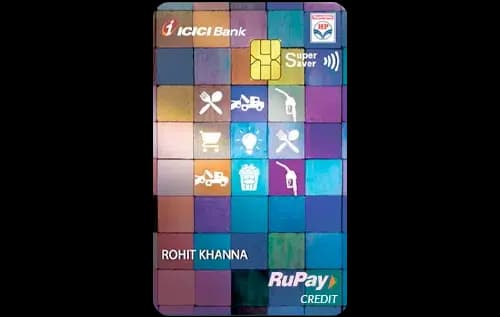
Quick Verdict
- For everyday spend, especially outside fuel and grocery categories, the ICICI HPCL Super Saver Credit Card ⓘ wins with a higher base reward rate of 1% compared to 0.4% on the RBL Bank ShopRite Credit Card ⓘ.
- Both cards offer 5% rewards on fuel and grocery spends, making them neck and neck in these categories.
- The ICICI HPCL Super Saver Credit Card ⓘ provides domestic lounge access, useful for frequent travelers, whereas the RBL ShopRite card does not.
- The RBL Bank ShopRite Credit Card ⓘ is cheaper to hold with no joining or annual fees, suitable for those wanting a free card with decent rewards.
- Choose the ICICI HPCL card ⓘ if you spend heavily outside the special categories and value lounge access, but pick the RBL ShopRite ⓘ if you want a no-fee card focused on fuel and grocery rewards.
Side by Side
| Detail | ICICI HPCL Super Saver Credit Card ⓘ | RBL Bank ShopRite Credit Card ⓘ |
|---|---|---|
| Annual fee | Rs 500 | Nil (lifetime free) |
| Joining fee | Rs 500 | Nil (lifetime free) |
| Fee waiver on spend | Rs 1.50 lakh | Rs 2.00 lakh |
| Reward rate | 1% base, 5% on fuel, utilities, grocery | 0.4% base, 5% on grocery, fuel |
| Reward type | points | points |
| Domestic lounge | 4 per year, Rs 75,000 quarterly spend gate | None |
| International lounge | None | None |
| Forex markup | 3.5% | 3.5% |
| Best suited for | fuel, grocery, cashback, shopping, lounge | cashback, grocery, fuel, shopping |
Rewards Compared
On a Rs 10,000 spend, the ICICI HPCL Super Saver Credit Card ⓘ yields Rs 100 back at its base level, rising to Rs 500 when spent on fuel, utilities, or grocery. The 1% base rate means everyday purchases outside these categories still earn a reasonable return, helping users accumulate rewards steadily. The category rate of 5% on specific spends is particularly lucrative for heavy users of fuel, groceries, or utilities, delivering up to Rs 500 back on every Rs 10,000 spent.
In contrast, the RBL Bank ShopRite Credit Card ⓘ offers Rs 40 back per Rs 10,000 at its base level, significantly lower than the ICICI card. However, it matches the 5% return on fuel and grocery, making it competitive for those categories. The absence of category rewards on utilities or other spends limits its versatility, but for shoppers focused largely on fuel and groceries, the rewards remain attractive.
Fees Compared
The ICICI HPCL Super Saver Credit Card ⓘ charges a Rs 500 joining fee and Rs 500 annual fee, which can be waived if you spend Rs 1.50 lakh annually or Rs 12,500 monthly. The card breaks even on fees at about Rs 50,000 of base spend per year, considering its higher base reward rate. The extra Rs 500 annual fee compared to the RBL card means you need to spend approximately Rs 83,333 more annually for the higher base rate to justify the cost.
The RBL Bank ShopRite Credit Card ⓘ has no joining or annual fees, making it an attractive zero-cost option. However, fee waiver on spend is set at Rs 2.00 lakh annually, but since fees are nil, the waiver is effectively irrelevant. The lower base reward rate means this card is best for those who want rewards without any fee burden.
Which One Should You Pick
The ICICI HPCL Super Saver Credit Card ⓘ suits a spender who values a higher base reward rate on everyday purchases and wants additional benefits like domestic lounge access. It is ideal for users with diverse spending habits who want to maximize returns on fuel, groceries, and utilities while also enjoying lifestyle perks. Those who do not mind paying an annual fee and can meet the waiver spend threshold will find it rewarding.
The RBL Bank ShopRite Credit Card ⓘ is best for budget-conscious users who want a no-fee card focused on high rewards in fuel and grocery categories but are less concerned about rewards on other spends or lounge access. It fits casual spenders or those looking for a simple rewards card without commitment to a fee.
Overall, the ICICI HPCL Super Saver Credit Card ⓘ emerges as the better all-rounder with more comprehensive rewards and privileges, while the RBL ShopRite ⓘ is a solid no-fee niche option. Skip the ICICI card if you want to avoid fees or spend predominantly outside its reward categories. Skip the RBL card if you want higher returns on all spends and lounge benefits.
What to Check Before You Apply
- Confirm the quarterly Rs 75,000 spend gate to access domestic lounges on the ICICI HPCL Super Saver Credit Card ⓘ.
- Check the redemption value and ease for reward points on both cards to ensure you get real value.
- Calculate your monthly spend to verify if you can realistically meet the fee waiver thresholds of Rs 12,500 for ICICI and Rs 16,667 for RBL.
- Be aware of the 3.5% forex markup on both cards, which makes them costly for international spends.
- Verify the availability and location of lounges accessible through the ICICI HPCL card, especially if you travel frequently.

Comments
No comments yet
Be the first to share your experience with this card.