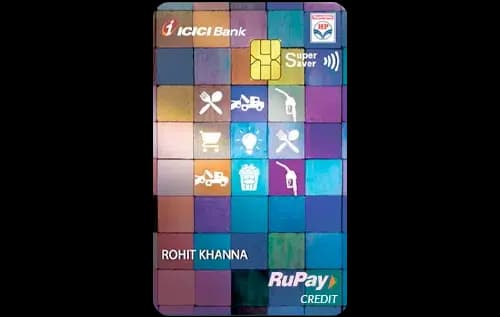
Quick Verdict
- The ICICI HPCL Super Saver Credit Cardⓘ wins for fuel, grocery, and utilities spending with a 5% reward rate in these categories.
- The Standard Chartered Rewards Credit Cardⓘ is better for online and dining spends, offering 4% rewards in those categories.
- The ICICI card is cheaper to hold if you meet the higher fee waiver spend of Rs 1.50 lakh annually, otherwise Standard Chartered’s card has no joining fee but a higher annual fee with a lower waiver threshold.
- Choose ICICI HPCL Super Saver for heavy fuel and grocery shoppers who spend more than Rs 12,500 monthly; pick Standard Chartered Rewards if you want a no-joining-fee card with decent rewards on dining and online spends.
Side by Side
| Detail | ICICI HPCL Super Saver Credit Cardⓘ | Standard Chartered Rewards Credit Cardⓘ |
|---|---|---|
| Annual fee | Rs 500 | Rs 1,000 |
| Joining fee | Rs 500 | Nil (lifetime free) |
| Fee waiver on spend | Rs 1.50 lakh | Rs 1.00 lakh |
| Reward rate | 1% base, 5% fuel, utilities, grocery | 1% base, 4% online, dining |
| Reward type | Points | Points |
| Domestic lounge | 4 per year | 4 per year |
| International lounge | None | None |
| Forex markup | 3.5% | 3.5% |
| Best suited for | fuel, grocery, cashback, shopping, lounge | rewards, dining, first-card, shopping, lounge |
Rewards Compared
On a Rs 10,000 general spend, both the ICICI HPCL Super Saver Credit Cardⓘ and the Standard Chartered Rewards Credit Cardⓘ provide a base return of Rs 100 in rewards. However, the ICICI card shines in fuel, grocery, and utilities categories by offering Rs 500 back on Rs 10,000 spent, which is a significant uplift over the base rate. This makes it an excellent choice for cardholders who regularly spend in these essential categories.
Conversely, the Standard Chartered Rewards Credit Cardⓘ targets the online and dining segments with a 4% return, equating to Rs 400 on Rs 10,000 spent in these categories. This is slightly lower than ICICI’s 5% in its specialized categories but still a strong reward rate for lifestyle and digital spends. Thus, your choice should align with your dominant spending habits, essential household and fuel expenses favor ICICI, while dining and online shopping favor Standard Chartered.
Fees Compared
The ICICI HPCL Super Saver Credit Cardⓘ charges a joining fee and an annual fee of Rs 500 each. However, these fees are waived if you spend Rs 1.50 lakh annually, which breaks down to Rs 12,500 per month. If you spend less than this, you will incur Rs 1,000 yearly in fees.
The Standard Chartered Rewards Credit Cardⓘ has no joining fee but a higher annual fee of Rs 1,000. This fee is waived if you spend Rs 1.00 lakh annually, or about Rs 8,333 monthly. The lower waiver threshold makes it easier to avoid fees here, but the overall annual fee is double that of the ICICI card if the waiver is not met.
In terms of break-even spends for fees at base reward rates, ICICI’s card requires Rs 50,000 in annual spend to cover fees via rewards, while Standard Chartered’s card demands about Rs 1.00 lakh. This means the ICICI card rewards pay off fees quicker for those sticking to base earn rates.
Which One Should You Pick
Choose the ICICI HPCL Super Saver Credit Cardⓘ if you spend heavily on fuel, groceries, and utilities. The 5% category reward rate is unmatched here, and if you can maintain Rs 12,500 monthly spending to waive fees, this card becomes very cost-effective. It also offers domestic lounge access for frequent travelers domestically.
On the other hand, the Standard Chartered Rewards Credit Cardⓘ suits those who prefer no joining fee and want decent rewards on dining and online shopping. Its lower fee waiver threshold of Rs 8,333 per month is easier to meet, making it a simpler choice for moderately high spenders. The card also gives a complimentary domestic lounge visit per calendar quarter, adding travel benefits.
Skip the ICICI card if your spending is below Rs 12,500 per month or if you rarely spend on fuel or groceries. Avoid the Standard Chartered card if you want to maximize rewards in fuel or grocery categories or if you dislike paying a Rs 1,000 annual fee without meeting waiver criteria.
What to Check Before You Apply
- Confirm if the reward points have any redemption caps or expiry that might limit your value.
- Check the actual value of points on redemption; not all points convert equally to rupees.
- Review fee waiver calculations carefully, monthly spend requirements may differ from your usual pattern.
- Consider the 3.5% forex markup cost if you plan to use the card abroad for foreign currency transactions.
- Verify the domestic lounge access conditions such as quarterly spend gates and lounge partner availability.

Comments
No comments yet
Be the first to share your experience with this card.