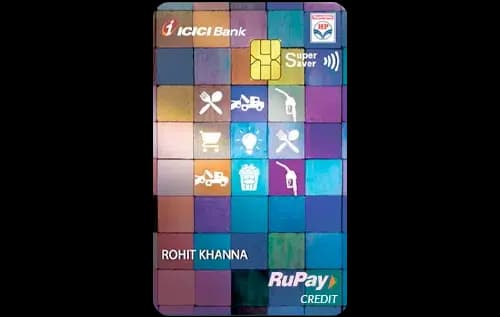
Quick Verdict
- The ICICI HPCL Super Saver Credit Cardⓘ wins for fuel, utilities, and grocery spend due to its 5% reward rate in these categories.
- The Yes Bank Rupay Credit Cardⓘ is better for users seeking a completely fee-free card with solid grocery and dining rewards.
- The Yes Bank Rupay card is cheaper to hold, having no joining or annual fee, while the ICICI HPCL card requires Rs 500 each, waivable on Rs 1.5 lakh annual spend.
- Pick the ICICI HPCL card for heavy fuel and grocery users willing to meet the higher fee waiver; choose the Yes Bank Rupay card for first-time cardholders or those preferring no fees and decent grocery/dining rewards.
Side by Side
| Detail | ICICI HPCL Super Saver Credit Cardⓘ | Yes Bank Rupay Credit Cardⓘ |
|---|---|---|
| Annual fee | Rs 500 | Nil (lifetime free) |
| Joining fee | Rs 500 | Nil (lifetime free) |
| Fee waiver on spend | Rs 1.50 lakh | Rs 75,000 |
| Reward rate | 1% base; 5% fuel, utilities, grocery | 1% base; 3% grocery, dining; 1% UPI |
| Reward type | points | points |
| Domestic lounge | 4 per year | 4 per year |
| International lounge | None | None |
| Forex markup | 3.5% | 3.5% |
| Best suited for | fuel, grocery, cashback, shopping, lounge | UPI-Rupay, rewards, grocery, first-card, shopping |
Rewards Compared
On a Rs 10,000 spend, the ICICI HPCL Super Saver Credit Cardⓘ returns Rs 100 at the base rate of 1%. However, it significantly outperforms the Yes Bank Rupay card in key categories such as fuel, utilities, and grocery, offering a 5% reward rate which translates to Rs 500 for every Rs 10,000 spent. This makes it highly attractive for consumers with fuel and grocery-heavy expenses.
The Yes Bank Rupay Credit Cardⓘ also yields Rs 100 at the base rate for general spend, but its category rewards peak at 3% for grocery and dining, giving Rs 300 per Rs 10,000 spend in these categories. The Rupay card also provides 1% rewards on UPI transactions, a category not covered by the ICICI HPCL card. Thus, while it offers lower category rewards than the ICICI HPCL card, it is still competitive for everyday grocery and dining expenses, especially for users valuing UPI rewards.
Fees Compared
The ICICI HPCL Super Saver Credit Cardⓘ carries a joining fee and annual fee of Rs 500 each, but both can be waived by spending Rs 1.50 lakh annually, which equates to Rs 12,500 per month. The card breaks even on fees through base rewards alone at Rs 50,000 spend per year, meaning users spending above this threshold start seeing net benefits.
In contrast, the Yes Bank Rupay Credit Cardⓘ is lifetime free with no joining or annual fees, and its fee waiver threshold is Rs 75,000 annually or Rs 6,250 monthly, which may relate to lounge access eligibility. This makes it a very cost-effective card for users with moderate spend who want to avoid fees altogether.
Which One Should You Pick
Choose the ICICI HPCL Super Saver Credit Cardⓘ if you spend heavily on fuel, grocery, and utilities and can comfortably meet the Rs 1.50 lakh annual fee waiver. Its higher category reward rates and domestic lounge access make it suitable for shoppers and commuters who want to maximize cashback and enjoy occasional lounge visits. However, skip this card if your spend is low or you prefer a zero-fee card.
The Yes Bank Rupay Credit Cardⓘ is ideal for first-time credit card users, those who want a fee-free card for basic rewards on grocery, dining, and UPI payments, and users who prefer simplicity without worrying about fee waivers. It also offers four domestic lounge accesses with a lower spend gate. However, skip it if you want better rewards on fuel or utilities or international lounge access.
Overall, the ICICI HPCL Super Saver Credit Cardⓘ is the better choice for category-focused spenders and those willing to pay fees for higher returns. The Yes Bank Rupay Credit Cardⓘ suits budget-conscious users looking for a straightforward, no-fee card with decent rewards.
What to Check Before You Apply
- Confirm the quarterly Rs 75,000 (ICICI) or Rs 50,000 (Yes Bank) spend gates required for domestic lounge access.
- Verify the redemption value and process for points, as both cards offer points but the actual value can vary.
- Understand the fee waiver math carefully; the ICICI HPCL card requires a high annual spend to waive fees.
- Consider the 3.5% forex markup on foreign currency spend, which applies equally to both cards.
- Check which airport lounges are accessible domestically and whether those locations align with your travel habits.

Comments
No comments yet
Be the first to share your experience with this card.