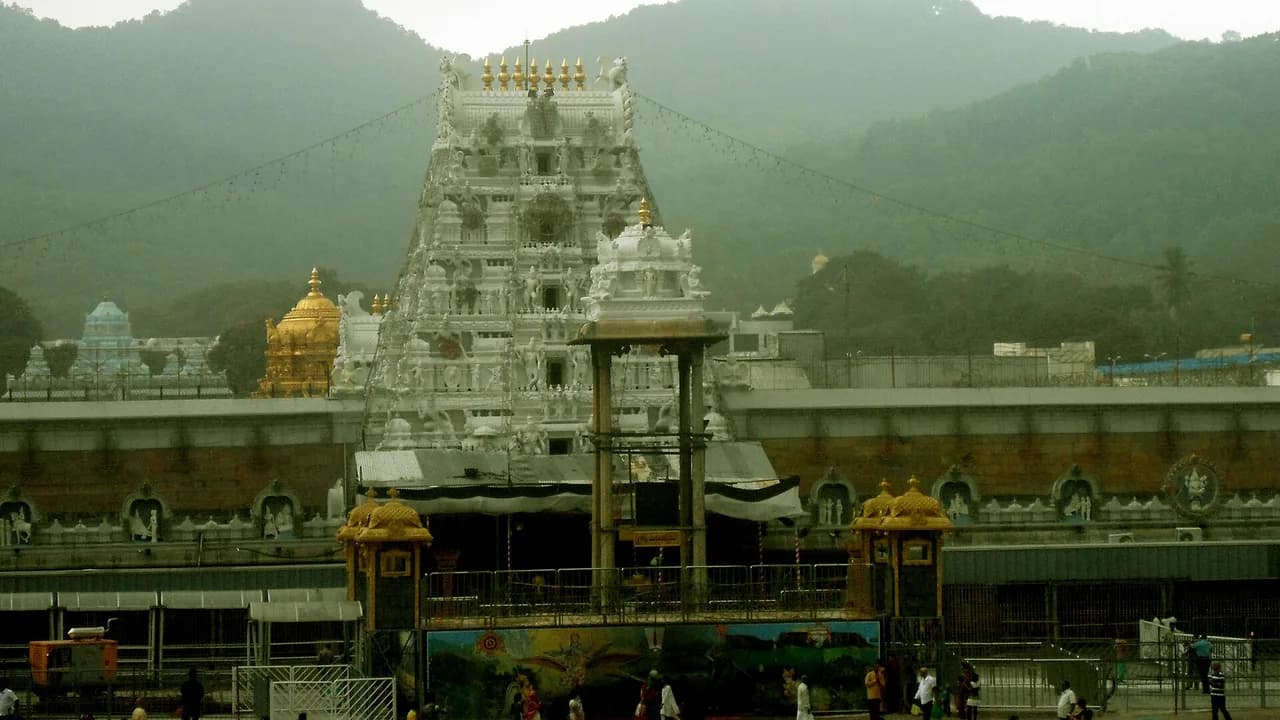
Tirupati and Temple-Town Hotel Bookings: Card Surcharges, Portals and Paying Smart
Published: 18 October 2026 Category: buying-guides | cardbuzz
Temple towns run on a different accommodation economy from business cities. In Tirupati, the trust-run rooms cost a few hundred rupees a night, the private hotels cluster around the railway station and the hill base, darshan slots are booked on a separate portal, and checkout happens at dawn because the temple — not the hotel — sets the schedule. For a credit-card user, the questions are practical: which booking channel earns rewards and which quietly adds fees, whether to prepay or pay at the property, and how the small surcharges (convenience fees, payment-gateway charges, GST on the room bill) change the final number.
Tirupati is the lead example here because its system is the most developed, but the mechanics — trust accommodation vs private hotels, OTA vs direct, prepaid vs pay-at-property — apply across Shirdi, Varanasi, Puri, Madurai and other pilgrimage centres.
The Three Kinds of Temple-Town Stays
1. Trust/dewasthanam accommodation. In Tirupati, the Tirumala Tirupati Devasthanams (TTD) runs the largest pilgrim accommodation system in the country — tens of thousands of rooms across Tirumala (the hill) and Tirupati town. Tariffs are deliberately nominal. TTD's published rates for its Tirupati complexes include:
- Srinivasam Complex (opposite the central bus stand): non-AC ₹200, AC ₹400, AC Deluxe ₹600 per day.
- Madhavam Guest House: AC Ordinary ₹800, AC Deluxe ₹1,000 per day.
- Vishnu Nivasam (facing the railway station): non-AC ₹300, AC ₹800 per day.
- Sri Venkateswara Dharmasala: ₹50–₹100 per day for basic dormitory-style beds.
These are base tariffs. GST applies on top, and a refundable caution deposit is collected at check-in — a real TTD receipt from January 2026 shows a ₹200 room becoming ₹210 after GST with a ₹211 caution deposit added, for a ₹421 total at the counter. Free dormitories exist at Kalyana Mandapam on a walk-in/token basis.
Three rules govern TTD rooms. Advance booking opens up to 90 days ahead on the official portal (tirupatibalaji.ap.gov.in) and requires a TTD online account; the hill rooms clear fastest. The stay window is 24 hours from check-in with no extensions, and overstaying is punished sharply — enhanced rent of 200% after 48 hours and 400% after 72 hours. And reporting windows are strict: online bookings carry a check-in time slot, and arriving outside it can mean the room is not allotted. Only Hindu pilgrims are eligible, and original ID proof (Aadhaar, voter ID, passport or driving licence) is mandatory at check-in.
2. State tourism hotels. Andhra Pradesh Tourism's Haritha hotels and similar state-run properties sit between trust rooms and private hotels on price, and they are bookable on the state tourism portal. They follow standard hotel billing — GST on the room tariff, card acceptance at the desk — making them the most "normal" option for card users who want a receipt that behaves like any other hotel stay.
3. Private hotels and lodges. The commercial market around Tirupati station, the bus stand and the Alipiri footpath base ranges from budget lodges to mid-range business hotels. These are listed on MakeMyTrip, Goibibo, Booking.com and Agoda, and they are where the card-payment mechanics in this guide matter most.
Darshan-Ticket Add-Ons: Book the Slot Before the Room
Temple-town hotel planning fails most often on sequencing: travellers book the room first and discover the darshan slots are gone. TTD's Special Entry Darshan (SED) — ₹300 per person — is booked on the same official portal as accommodation, and on peak weekends and festival dates both vanish within minutes of quota release.
The card-relevant point: TTD's portal is a government payment gateway. It accepts cards, but it is not a rewards-rich merchant — expect the base earn rate of the card, not an accelerated travel rate, and note that some issuers treat government/utility MCCs conservatively. The ₹300 SED charge and the room tariff are separate transactions; if the card has a per-transaction minimum for rewards, the small room tariff (₹200–₹600) may fall below it. None of this is a reason to avoid the portal — the tariffs are a fraction of private-hotel rates — but set reward expectations accordingly.
IRCTC's tourism packages (such as the ₹990 Tirupati day package, widely advertised as a starting price) bundle the SED slot with transfers, which removes the quota race entirely — at the cost of a fixed itinerary and no hotel.
Booking Channels: OTA vs Direct vs Walk-In
For private hotels, three channels compete, and the price the traveller sees is shaped by who takes a cut:
- OTAs (MakeMyTrip, Goibibo, Booking.com, Agoda). The platforms take 18–23% commission from independent hotels (higher for preferred-partner visibility tiers), which is why the same room is sometimes cheaper when booked direct — the hotel can afford to share part of the saved commission. OTAs counter with coupon codes, wallet cashback and card-specific offers. Convenience fees may appear at checkout; India's dark-pattern guidelines (2023) define drip pricing — revealing mandatory fees only at the payment step — as a deceptive practice, yet the Indian Express reported in October 2026 that travel aggregators still reveal convenience charges only at the final "proceed to pay" stage. Always carry the booking to the payment page before comparing.
- Direct booking (hotel website, phone, WhatsApp). No platform commission, often a small discount or a free early check-in for darshan-day arrivals, and the hotel's own cancellation terms — which are frequently more flexible than OTA prepaid rates. The trade-off: no OTA price protection and fewer payment options.
- Walk-in. Viable in temple towns on ordinary weekdays — lodges near the station rarely fill completely — but a gamble on weekends, festival dates and Brahmotsavam-type events, when the entire town sells out.
The card angle: OTAs reliably accept cards and generate clean, itemised invoices (useful for company reimbursements and for cards that reward travel MCCs). Direct bookings at small lodges may be cash or UPI only at the desk — confirm card acceptance before committing, especially for late-night arrivals.
Convenience Fees and Payment-Gateway Surcharges at Checkout
Two distinct charges can inflate an online hotel booking, and they are often confused:
- Platform convenience fee. The OTA's own charge for the booking service, revealed at checkout. It is non-refundable even if the booking is cancelled within a free-cancellation window — the room refund comes back, the fee does not.
- Payment-gateway surcharge. Some merchants add a percentage for card payments to offset the MDR (merchant discount rate) they pay their bank. On government portals and smaller hotel websites, a 1–2% card surcharge is common; large OTAs typically absorb it.
The comparison that matters: a "₹2,400 room" that becomes ₹2,700 at the OTA checkout (convenience fee + taxes) versus a ₹2,500 direct rate with no fee. The card rewards on the OTA booking (say 2–5% on travel) rarely close a gap that wide — a ₹200 fee wipes out the reward value on a ₹2,500 booking several times over. Compare final payable amounts, not headline rates.
Prepaid vs Pay-at-Property: Which Earns Rewards and Which Does Not
This is the single most consequential choice for rewards:
- Prepaid (pay online now). The full amount is charged to the card at booking. It earns rewards at the card's online/travel rate, locks the price, and generates an immediate invoice. The risk is cancellation terms — prepaid rates are often non-refundable or carry a deduction, and the convenience fee portion is non-refundable regardless.
- Pay-at-property. Nothing is charged until check-in (the OTA may take a card guarantee or a token pre-authorisation). Rewards are earned only on the amount actually charged at the desk — and the desk charge is processed on the hotel's own terminal, coded as the hotel's MCC. For most cards this still earns the standard rate, but some cards exclude or reduce earnings on certain lodging MCCs, and the desk may add its own card surcharge.
A subtle trap: a "pay at property" booking where the traveller pays via a link or QR the hotel sends on WhatsApp. That payment may route through a payment aggregator or even a personal UPI handle — rewards treatment becomes unpredictable, and there is no OTA invoice. For reward certainty, prepaid on the OTA or a card swipe at the hotel's own POS terminal are the two clean paths.
Refunds route back to the source. A cancelled prepaid booking refunds to the same card — typically within 5–10 working days via the OTA and the issuing bank. A pay-at-property booking that is cancelled costs nothing (unless the rate had a no-show clause, which authorises the guaranteed card for one night).
GST on the Room Bill: The Current Slabs
Since 22 September 2026-era reform (effective 22 September 2025, per the 56th GST Council decision), hotel GST is a two-slab system:
- Room tariff up to ₹7,500 per night: 5% GST (no input tax credit).
- Room tariff above ₹7,500 per night: 18% GST (ITC available).
The old 12% slab is gone, and the slab is determined by the actual transaction value per night, not the printed tariff card — so a discounted ₹8,000 room billed at ₹7,200 falls in the 5% slab. For temple-town budgets, nearly every stay lands in the 5% slab: a ₹3,000 room now carries ₹150 GST instead of the earlier ₹360, and a ₹6,000 room carries ₹300 instead of ₹720. TTD's own rooms, at ₹200–₹1,000, sit at the very bottom of the same slab. Restaurant food at the hotel is generally 5% without ITC.
POS Surcharges and Desk Pitfalls
At the property, watch for:
- Card surcharges at small lodges. A 1–2% "card charge" at the desk is common in budget properties. On a ₹2,000 bill, a 2% surcharge (₹40) roughly cancels a 2% reward earn — paying by UPI (where accepted without fee) can be the better move for the base amount, while keeping the card for the incidentals that earn accelerated rewards.
- Dynamic currency conversion. Largely an international-traveller issue, but NRI pilgrims paying with foreign cards should always choose INR at the terminal, never the "home currency" option.
- Pre-authorisation holds. Hotels that take a card guarantee may place a hold of one night's tariff. The hold releases after checkout, but it temporarily reduces the available limit — relevant when the same card is also carrying the darshan, travel and shopping spends of the trip.
- Cash-only ancillaries. Temple-town extras — prasadam counters, tonsure services, shoe-keeping, special-entry queues at associated shrines — are overwhelmingly cash or UPI. Budget a cash float; no card strategy covers the hundi.
Putting It Together: A Card Strategy for the Temple Town
- TTD rooms and SED slots: book on the official portal as early as the 90-day window allows; pay by card, expect base earn rates, and keep the receipt — the caution deposit refund tracks back to the payment source.
- Private hotels: compare the OTA's final payable (after the drip-priced convenience fee) against the hotel's direct rate; prepaid earns rewards cleanly, pay-at-property keeps flexibility.
- At the desk: confirm card acceptance and any surcharge before handing over the card; a 2% surcharge on a budget bill usually beats the reward.
- Keep one card's limit headroom for the guarantee hold, and carry a UPI backup for the cash-only economy around the temple.


Comments
No comments yet
Be the first to share your experience with this card.