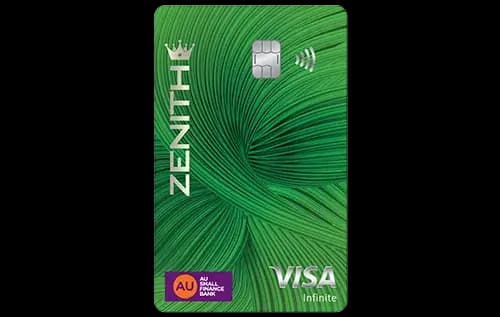
Quick Verdict
- For everyday spend, both the Zenith Credit Card ⓘ and the HSBC Travelone Credit Card ⓘ offer a base reward rate of 1%, resulting in Rs 100 back on Rs 10,000 spent, so they are neck and neck.
- For travel and dining categories, the Zenith Card shines with a 5% return compared to HSBC’s 3%, making it better for category spenders.
- HSBC Travelone is cheaper to hold with a Rs 4,999 joining and annual fee versus Rs 7,999 each for Zenith, and it also has a lower forex markup of 0.99% versus 1.99%.
- Pick Zenith if you want premium travel benefits, higher category rewards, and are willing to spend heavily to justify fees. Choose HSBC Travelone for better forex costs, more affordable fees, and solid travel perks without a very high spend commitment.
Side by Side
| Detail | Zenith Credit Card ⓘ | HSBC Travelone Credit Card ⓘ |
|---|---|---|
| Annual fee | Rs 7,999 | Rs 4,999 |
| Joining fee | Rs 7,999 | Rs 4,999 |
| Fee waiver on spend | Rs 8.00 lakh annual (Rs 66,667/month) | |
| Reward rate | 1% base, 5% dining & travel | 1% base, 3% dining & travel |
| Reward type | points | points |
| Domestic lounge | 8 per year | 8 per year |
| International lounge | 6 per year | 6 per year |
| Forex markup | 1.99% | 0.99% |
| Best suited for | premium, travel, lounge, rewards, dining, shopping | travel, rewards, lounge, forex, shopping |
Rewards Compared
Spending Rs 10,000 on everyday purchases with either card yields Rs 100 in returns, as both offer a 1% base reward rate. However, where these cards differ significantly is in their category-specific rewards. The Zenith Credit Card ⓘ awards 5% back on dining and travel categories, translating to Rs 500 on Rs 10,000 spent in these areas. This is notably higher than the HSBC Travelone Credit Card ⓘ, which offers a 3% return, or Rs 300 on the same spend categories. For users who prioritize dining and travel expenses, Zenith provides a substantially better reward payout.
For general spenders, both cards deliver the same 1% base reward rate, but Zenith’s higher category rates make a strong case for those who can leverage these benefits. HSBC’s consistent 3% category rewards are respectable but don’t match Zenith’s premium returns.
Fees Compared
The Zenith Credit Card ⓘ charges a hefty joining and annual fee of Rs 7,999 each, with no explicit fee waiver on annual spend. This means the cardholder must generate significant value, about Rs 7,99,900 or roughly Rs 8 lakh in spend, to recover the annual fee purely through base rewards. The Zenith card’s monthly spend equivalent to break even is quite steep.
In contrast, the HSBC Travelone Credit Card ⓘ comes with lower fees of Rs 4,999 for both joining and annual charges. It also offers a fee waiver if you spend Rs 8 lakh annually, which breaks down to Rs 66,667 monthly. The break-even spend to cover the base fee is approximately Rs 4,99,900 or Rs 5 lakh annually, much more achievable for many users compared to Zenith. This makes HSBC Travelone a more accessible option for those cautious about fees.
Which One Should You Pick
Choose the Zenith Credit Card ⓘ if you are a premium traveller or a big spender who values high category rewards on dining and travel, and you want extensive lounge access with concierge services. This card suits those who regularly spend large amounts and can maximize the Rs 20,000 quarterly lounge spend to unlock complimentary visits. Avoid this card if you have moderate spending or are fee-sensitive.
Pick the HSBC Travelone Credit Card ⓘ if you want a travel-focused card with lower fees, excellent forex rates at 0.99%, and decent rewards on travel and dining. The additional perks like golf access and instant air miles conversion make it appealing to frequent travellers who want value without a very high spend hurdle. Avoid this card if you do not meet the Rs 8 lakh annual spend for fee waiver or if you seek the highest category rewards.
Overall, HSBC Travelone Credit Card wins for cost efficiency and forex, while Zenith Credit Card wins in premium category rewards and benefits. For most users, HSBC Travelone offers a balanced travel and rewards experience at a more affordable price point.
What to Check Before You Apply
- Confirm the quarterly lounge spend gates on Zenith Card to ensure you can unlock all domestic lounge visits.
- Check the redemption value and flexibility of reward points, as both cards use points but details may vary on conversions.
- Carefully calculate the fee waiver threshold on HSBC Travelone; missing the Rs 8 lakh annual spend means paying Rs 4,999 yearly.
- Consider your forex spend: HSBC’s 0.99% markup is significantly cheaper than Zenith’s 1.99%, impacting overseas transaction costs.
- Verify which airports support the domestic and international lounge access for each card to avoid surprises.

Comments
No comments yet
Be the first to share your experience with this card.