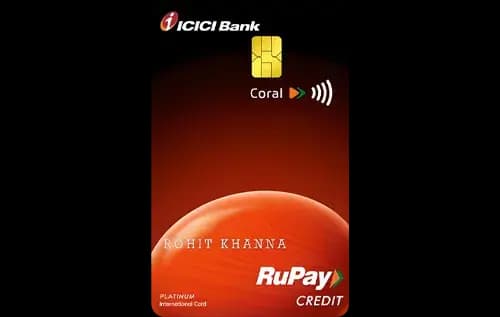
Quick Verdict
- For everyday spends and rewards, the Yes Bank Rupay Credit Cardⓘ wins with a higher base reward rate and superior category bonuses.
- For travel or lounge access, the ICICI Bank Coral Credit Cardⓘ offers better value with four complimentary domestic lounge visits, although both cards provide the same number of lounges.
- The Yes Bank Rupay Credit Card is cheaper to hold with no joining or annual fees, compared to ICICI Coral’s Rs 500 fees.
- Choose the ICICI Coral if you want lounge benefits and moderate rewards with a fee waiver on Rs 1.5 lakh annual spend; pick the Yes Bank Rupay card for a fee-free, higher-reward card ideal for grocery, dining, and UPI users.
Side by Side
| Detail | ICICI Bank Coral Credit Cardⓘ | Yes Bank Rupay Credit Cardⓘ |
|---|---|---|
| Annual fee | Rs 500 | Nil (lifetime free) |
| Joining fee | Rs 500 | Nil (lifetime free) |
| Fee waiver on spend | Rs 1.50 lakh | Rs 75,000 |
| Reward rate | 0.5% base | 1% base |
| Reward type | Points | Points |
| Grocery category rate | 1% | 3% |
| Utilities category rate | 1% | Not recorded |
| Dining category rate | Not recorded | 3% |
| UPI category rate | Not recorded | 1% |
| Domestic lounge | 4 per year (Rs 75,000 quarterly spend gate) | 4 per year (Rs 50,000 quarterly spend gate) |
| International lounge | None | None |
| Forex markup | 3.5% | 3.5% |
| Best suited for | First card, rewards, dining, lounge | UPI-Rupay, rewards, grocery, first card, shopping |
Rewards Compared
Spending Rs 10,000 on the ICICI Bank Coral Credit Cardⓘ earns Rs 50 in rewards at the base rate of 0.5%. This card boosts returns to Rs 100 on grocery and utilities spends due to its 1% category rate, making these expense types more rewarding than standard spends. On the other hand, the Yes Bank Rupay Credit Cardⓘ doubles the base reward to Rs 100 per Rs 10,000 spent, and excels in specific categories: it offers 3% returns on grocery and dining, translating to Rs 300 back on Rs 10,000 in those categories. Additionally, UPI transactions yield a 1% return or Rs 100 per Rs 10,000. This makes the Rupay card substantially more rewarding for grocery and dining spenders, while the ICICI Coral is more focused on utility payments and moderate rewards.
Fees Compared
The ICICI Bank Coral Credit Card charges Rs 500 as both joining and annual fees, with a waiver available if you spend Rs 1.5 lakh annually, which breaks down to Rs 12,500 monthly. This requires a relatively high monthly spend to avoid fees. The Yes Bank Rupay Credit Card, however, is lifetime free with no joining or annual fees, and its fee waiver threshold at Rs 75,000 annual spend or Rs 6,250 monthly effectively means no fee ever applies. The Coral card requires Rs 1,00,000 spend approximately to cover its base annual fee through rewards, while the Rupay card’s zero fees make it cost-effective from the outset.
Which One Should You Pick
Choose the ICICI Bank Coral Credit Cardⓘ if you are a first-time card user looking for some lounge benefits alongside decent rewards on utilities and grocery. If you regularly spend over Rs 12,500 per month and value domestic lounge access, this card can justify its fees. It also suits dining enthusiasts who want a moderate rewards structure combined with lifestyle perks.
The Yes Bank Rupay Credit Cardⓘ is better suited for those who want a no-fee card with high reward rates, especially on grocery and dining. It is ideal for UPI users and shoppers who want to maximize returns without worrying about fees or spend thresholds. This card fits well as a primary card for everyday transactions.
In a decisive call, the Yes Bank Rupay Credit Card edges ahead as the better all-rounder for rewards and cost-effectiveness. Skip the Coral card if you want to avoid fees and are not focused on lounges. Conversely, skip the Rupay card if you prioritize lounge access and can meet the Coral’s higher spend requirement.
What to Check Before You Apply
- Confirm the quarterly spend gates for domestic lounges: Rs 75,000 for Coral and Rs 50,000 for Rupay, to ensure you qualify for lounge visits.
- Check the redemption options and value of points, as reward points may have different redemption values or restrictions.
- Understand the fee waiver math: Coral requires Rs 1.5 lakh annual spend, Rupay is lifetime free but mentions a Rs 75,000 spend waiver for clarity.
- Remember both cards have a 3.5% forex markup, making them costly for foreign currency transactions.
- Verify the lounge locations and whether lounge access aligns with your travel habits, as neither card offers international lounge access.

Comments
No comments yet
Be the first to share your experience with this card.