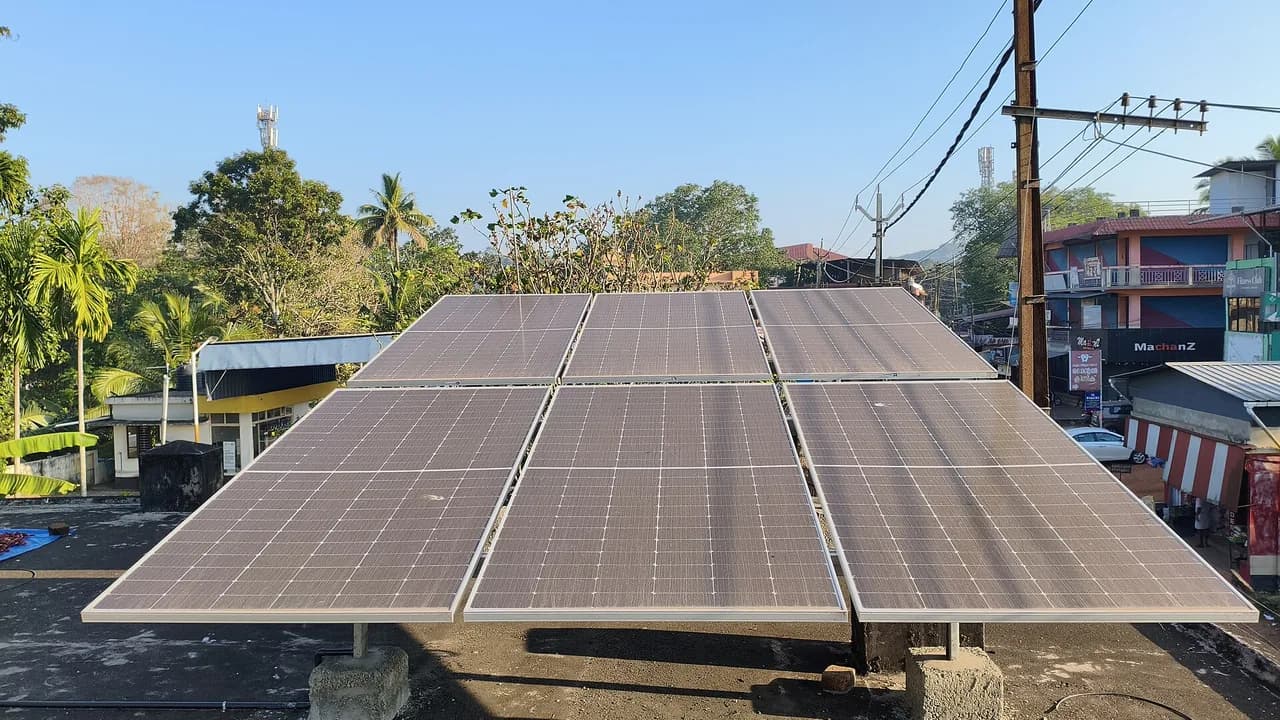
Rooftop Solar on a Credit Card: EMI vs Solar Loan, the Full Maths
Published: 18 October 2026 Category: comparisons | cardbuzz
Rooftop solar is one of the largest single purchases a household makes — a 3 kW system costs roughly ₹1.5–2.1 lakh installed, according to industry estimates cited by the Financial Express in October 2026. That puts it squarely in the zone where the payment instrument matters: the difference between card EMI, a dedicated solar loan, and upfront payment can shift the net cost by tens of thousands of rupees. This guide works through the maths of all three routes, plus the one move that makes the biggest difference of all — prepaying with the PM Surya Ghar subsidy.
The cost baseline: what a 3 kW system really costs
The PM Surya Ghar Muft Bijli Yojana pays central financial assistance of ₹30,000 per kW for the first 2 kW and ₹18,000 for the third kW — so ₹30,000 for 1 kW, ₹60,000 for 2 kW, and a hard cap of ₹78,000 for systems of 3 kW or larger. Larger systems get no additional central subsidy. Some states add their own top-ups — Uttar Pradesh adds ₹15,000 per kW (capped at ₹30,000 per consumer), Rajasthan offers additional assistance under its 150 Unit Nishulk Bijli Yojana, and Tamil Nadu provides a flat ₹20,000 incentive.
On a base-case 3 kW system at ₹2.05 lakh, the ₹78,000 central subsidy takes the net cash outlay to roughly ₹1.27 lakh. But the subsidy is credited directly to the homeowner's bank account after installation and commissioning — typically within 15–30 days — not deducted from the installer's invoice. The installer is paid the full amount first. That sequencing is what makes financing choice so important.
Route 1: credit card EMI
Paying the installer with a credit card and converting the transaction to EMI is the fastest route — settlement is instant, and reward points or cashback on the initial swipe can add a genuine sweetener. A ₹2.05 lakh swipe at, say, 1.5% effective reward value returns around ₹3,000 in points, assuming the card rewards the merchant category.
The catch is the interest rate. Card EMI tenures typically run 12–24 months at effective annual rates of roughly 13–16%, with some issuers charging up to 18% plus a one-time processing fee of 1–2%. Take ₹2.05 lakh at 15% over 24 months: the monthly EMI works out to roughly ₹9,970, and total interest paid is about ₹34,300. Even after accounting for rewards, this is by far the most expensive financing route. Card EMI makes sense only for short tenures (6–9 months) where the interest hit is contained — or when the purchase coincides with a merchant's own no-cost EMI offer, where the issuer or brand absorbs the interest.
One warning: large credit utilisation in a single swipe can dent the credit score temporarily (utilisation is a major scoring factor), and the subsidy arrives in the bank account — not on the card — so it cannot directly offset the card balance unless routed manually.
Route 2: the PM Surya Ghar solar loan
This is the route the scheme was designed around. Public-sector banks — SBI, Canara Bank, Bank of Baroda, PNB, Indian Bank, Bank of Maharashtra, Union Bank and Bank of India — offer collateral-free rooftop solar loans of up to ₹2 lakh. As of September 2026, the concessional rate at these banks is about 5.75% per annum (typically EBLR-linked, so it moves with the RBI repo rate), with repayment tenures of up to 10 years, applied through the Jan Samarth portal. The scheme's own guidelines cite a subsidised rate of around 7% — the actual current rate at most PSU banks is the lower 5.75% figure.
Run the numbers on the same ₹2.05 lakh: the bank finances roughly 90% of project cost, so a loan of about ₹1.84 lakh at 5.75% over 10 years gives an EMI of roughly ₹2,020 per month. Total interest over the full tenure is about ₹58,000 — but the tenure rarely runs full, because of route 3.
Route 3: loan plus subsidy prepayment — the optimal combination
The subsidy and the loan are stackable. The recommended strategy, confirmed by lender disclosures, is: take the solar loan for the full gross cost, then when the ₹78,000 subsidy lands in the bank account (30–45 days after commissioning), prepay the loan principal. There is no prepayment penalty on these loans.
Revisiting the example: on a ~₹1.72–1.84 lakh loan, the ₹78,000 subsidy prepayment drops the outstanding principal to roughly ₹94,000–1.06 lakh. One worked example puts the resulting EMI at about ₹1,032 per month at 5.75% over 10 years — less than many households' pre-solar electricity bills. Total interest collapses to roughly ₹15,000–20,000 across the tenure. That is a fraction of the ₹34,000+ interest on a 2-year card EMI, on a far more comfortable monthly outflow.
The head-to-head maths
| Route | Outflow shape | Interest cost (indicative) | Verdict |
|---|---|---|---|
| Full payment upfront | ₹2.05 lakh out, ₹78,000 back in ~30 days | Zero | Best if cash is available and an emergency fund stays intact |
| Card EMI (24 months, ~15%) | ~₹9,970/month | ~₹34,000 | Convenient but the priciest; only for short tenures |
| Solar loan alone (10 yrs, 5.75%) | ~₹2,020/month | ~₹58,000 (rarely paid in full) | Good baseline |
| Solar loan + subsidy prepay | ~₹1,032–1,100/month | ~₹15,000–20,000 | The cheapest financed route |
Figures are illustrative, computed from the verified subsidy slabs and the SBI loan terms cited above.
What the payback period looks like
Subsidised payback estimates vary sharply by state tariff. Industry estimates (Isma, October 2026) put the payback of a subsidised 3 kW system at about 2.2 years in Maharashtra, 5 years in Uttar Pradesh, 6.7 years in Tamil Nadu and 7.8 years in Gujarat — driven by state tariffs and the state-level top-ups. Financing choice shifts these by months, not years; the dominant variables remain system cost, local sunshine, and the tariff.
The card still has a role
None of this means the credit card sits out entirely. The card is the right instrument for the smaller solar-adjacent spends: the net-meter application fee, the DISCOM's meter charges, annual maintenance contracts, and replacement of monitoring hardware — all modest tickets where reward points are not cancelled out by interest, since these are paid in full each month. And for households that cannot access the Jan Samarth loan quickly enough, a short card-EMI bridge (6–9 months) on part of the cost, converted before the first billing cycle, is a workable interim — provided the balance is cleared well before standard revolving rates apply.
Card EMI vs personal loan: the middle option buyers forget
Between the 15%-ish card EMI and the 5.75% solar loan sits the ordinary personal loan or consumer-durable loan at roughly 11–13% — worth knowing about because the Jan Samarth loan, while cheapest, takes 7–21 working days and requires the full document set. If the installer offers a limited-time discount for immediate payment, a personal loan drawn in 48 hours can capture it.
On ₹1.5 lakh at 12% over 24 months, the EMI is about ₹7,050 and total interest roughly ₹19,300 — materially cheaper than card EMI at 15%+ (about ₹27,000 interest on the same amount and tenure). The card still wins for the rewards earn on the initial swipe, so the optimal hybrid is: swipe the card for the points, then use the personal loan to clear the card before revolving interest starts. Never let a large solar swipe sit on the card at standard revolving rates of 3–4% per month — that compounds to an effective annual rate north of 40%, and it will devour the subsidy in months.
The credit-score angle
A ₹2 lakh swipe can push utilisation above 50–80% of the credit limit in a single day, and utilisation is one of the heaviest factors in credit scoring. The dip is temporary — scores recover as the balance is paid down — but timing matters: don't take the solar swipe in the same quarter as a home-loan or car-loan application. If the limit is a constraint, ask the issuer for a temporary limit enhancement for the purchase month; many issuers grant these against a good repayment history. Alternatively, split the installer payment across two cards to keep per-card utilisation lower — just confirm the installer doesn't add a surcharge per transaction.
A worked example: the 3 kW decision
Household: monthly bill ₹2,200, sanctioned load 5 kW, terrace with clear sun.
- Quote: ₹1.95 lakh gross for 3 kW (on-grid, net metering, 5-year comprehensive warranty).
- Subsidy: ₹78,000 central (no state top-up in this state). Net cost: ₹1.17 lakh.
- Financing chosen: Jan Samarth solar loan of ₹1.75 lakh at 5.75% for 10 years → EMI ≈ ₹1,925.
- Subsidy lands on day 38 → ₹78,000 prepaid against principal → balance ≈ ₹97,000 → EMI effectively ≈ ₹1,060 (or keep the EMI and finish years early).
- Monthly bill after solar: roughly ₹200–400 (fixed charges plus night-time draw). Monthly saving vs the old ₹2,200 bill: about ₹1,800–2,000 — comfortably above the ₹1,060 EMI from month two onward.
The system is cash-positive from the second month, and the loan is gone in under a decade while the panels carry a 25-year performance warranty. That is the shape of a good solar financing decision — and the card's role in it was limited to the ₹3,000-odd in rewards earned on the milestone swipes, cleared in full each cycle.
The hierarchy, then: cash if available, solar loan plus subsidy prepay if financing is needed, and card EMI only for the short, small, or no-cost-EMI edge cases. The subsidy does the heavy lifting in every scenario — the payment route decides how much of that lifting leaks away as interest.


Comments
No comments yet
Be the first to share your experience with this card.